PRIMUS · MARINE LAUNDRY · SPARE PARTS
Marine Technic helps you select Primus laundry equipment for your vessel and find the right spare parts. From machine selection to detergent dosing, we focus on practical solutions for everyday operation.
Machine identification
Full model and serial number
Equipment for your vessel
Professional washing and drying
Version-aware enquiry
Part number and catalogue notes
One parts enquiry
Multiple lines and your own files
SPECIFY FOR THE VESSEL
We value the combination of professional washing and drying equipment, hardmount options for marine installations and a documented spare parts range. It lets us consider the complete laundry setup and its ongoing maintenance together. Our recommendation starts with your vessel: we match the machine configuration to its electrical supply, foundation, space and workload.
Send the voltage, frequency and number of phases from the vessel’s supply and the existing machine’s nameplate. A model name alone does not identify its electrical configuration.
Check the foundation, fixing arrangement, door clearance, loading space and access for maintenance or eventual replacement. Match water, drainage and dryer ventilation to the selected equipment.
Specify the daily volume, textile types, available operating hours and required turnaround. Consider washing and drying together, including the moisture remaining after extraction.
UNDERSTAND THE RANGE
Explore a selection of Primus laundry equipment below. If you need a different model, contact Marine Technic to discuss your requirements. We help narrow the choice by capacity, mounting arrangement and onboard requirements, then confirm the exact version and configuration.
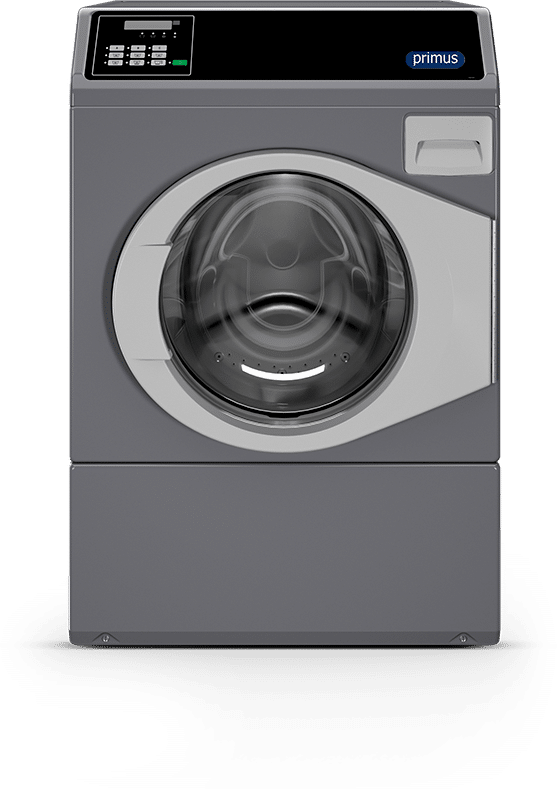
We recommend considering SP10 and SPC10 when you need a compact professional washer. SPS10 and SPSC10 bring washing and drying together in a stacked arrangement to make use of vertical space. The current SP range offers freestanding construction and 440 G extraction; we confirm the specification of the version offered.
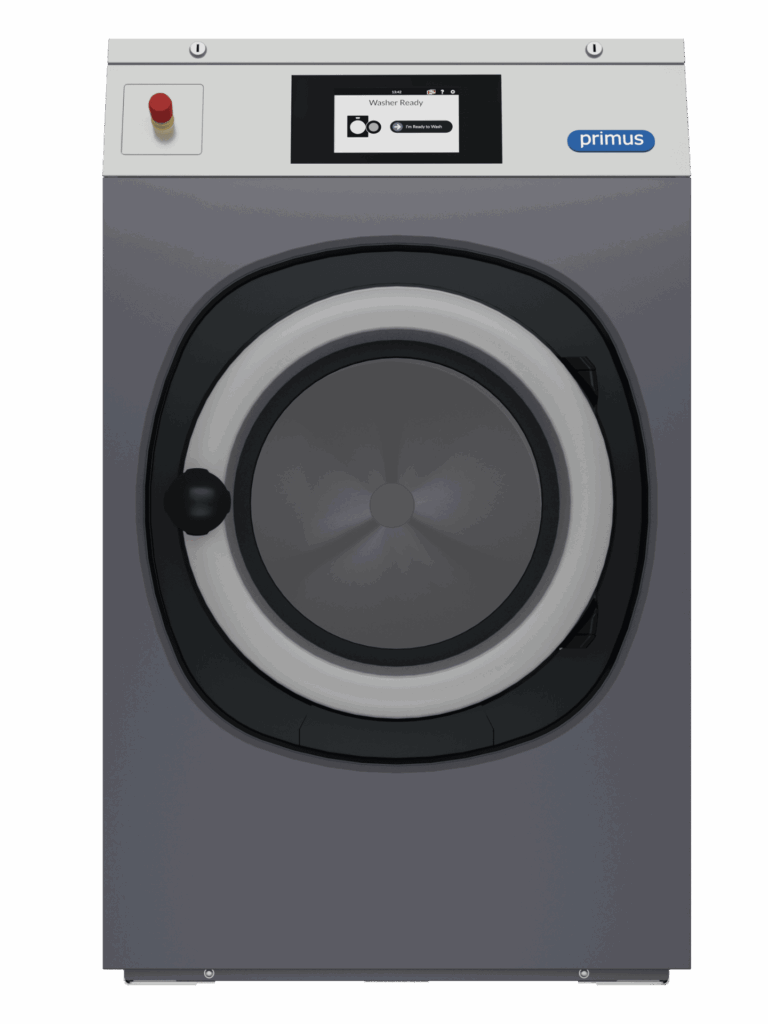
RX is a starting point we consider for a fixed installation aboard a vessel. Its hardmount construction makes the foundation and fixing arrangement central to the selection. We review those requirements alongside capacity, access and the vessel’s electrical supply.
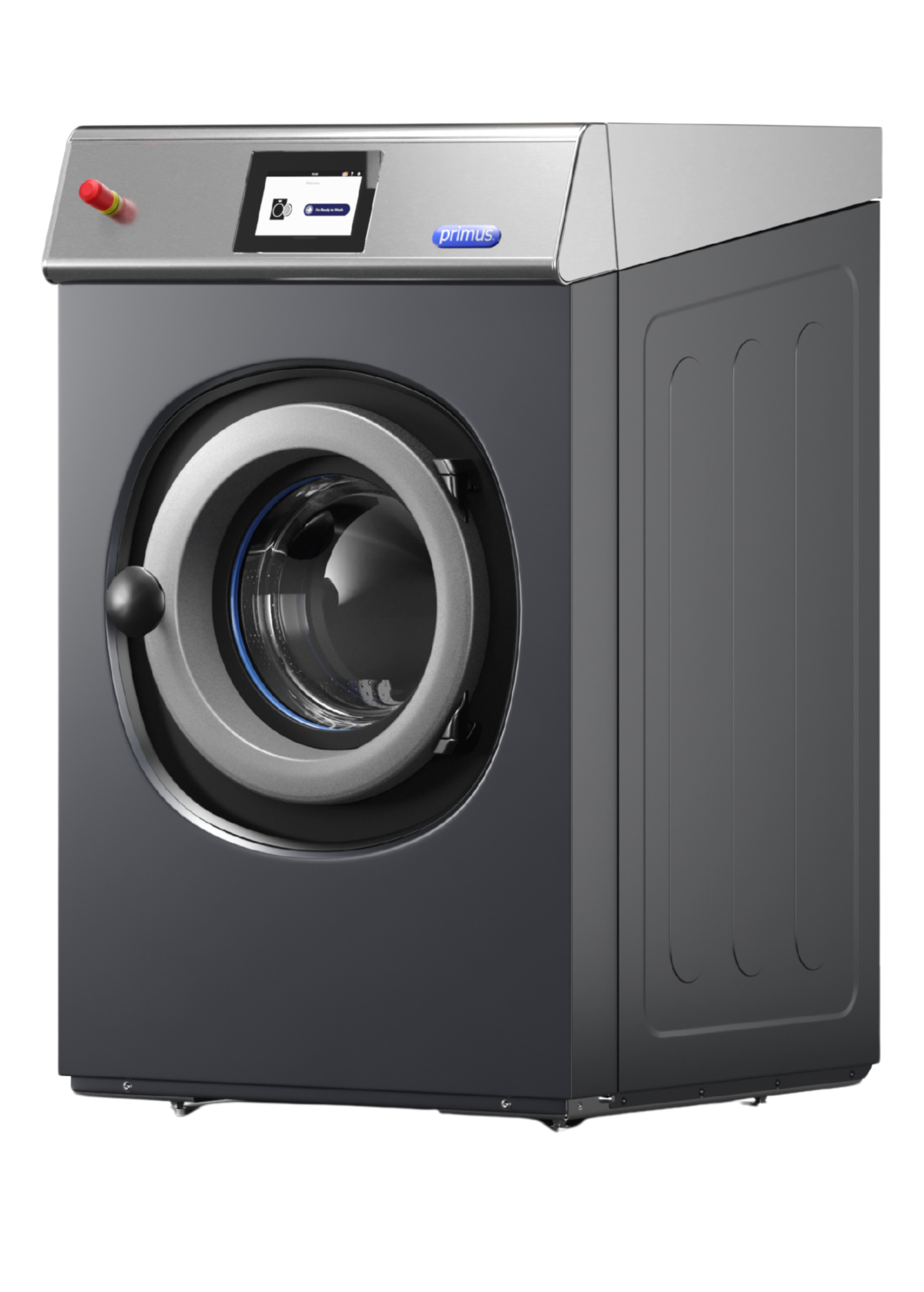
We consider FX where a suspended washing assembly and high extraction performance suit the installation. Selected configurations also offer load-based resource controls. Current FX65–FX105 specifications include 500 G extraction; we check the exact version before recommending it.
TECHNOLOGY WITH A PRACTICAL PURPOSE
We highlight Primus technologies for the practical tasks they support: consistent wash programmes, controlled dosing, effective extraction and drying control. We help identify which functions are useful for your crew and available on the machine configuration you need.
We value the focus on washing action and extraction. The drum surface, perforations and raised shapes are designed to support both, while helping laundry release from the drum after extraction.
A clear control interface matters when different crew members operate the laundry. XControl FLEX+ supports configurable wash programmes and multilingual guidance. Display size and language options depend on the machine and control version.
Variable loads make load-based controls worth considering. Ultrabalance estimates the load through the frequency converter; Smartload uses a weight entered by the operator. These functions adapt water and detergent use on supported configurations.
We highlight automatic dosing when repeatable chemical quantities are a priority. EasySOAP supports connections for up to eight dosing pumps, allowing the dosing arrangement to be specified alongside the wash programmes.
For vessels that need machine status, alerts or wash records, we can assess whether i-Trace fits the setup. It requires compatible controls, a suitable gateway and an internet connection, so onboard connectivity is part of the discussion.
We consider moisture control and heat recovery when selecting a dryer. SensoDry monitors residual moisture to help avoid overdrying; EVO7 heat-pump technology recirculates process air and heat. We confirm which options suit the exact dryer and installation.
CONTROL YOUR DETERGENT USE
If detergent is measured by eye, the dose can vary from one operator to the next. We see automatic dosing as a practical option to assess when a vessel wants more consistent washing and better control of chemical use.
EasySOAP connects to up to eight dosing pumps to deliver laundry chemicals automatically during the wash cycle. It reduces manual addition and supports repeatable dosing on compatible equipment.
Send us your machine details, current detergent, typical loads and an indication of consumption. We can discuss what needs checking for an automatic dosing setup, including machine compatibility, pumps and the chemical supplier’s dosing requirements.
A useful trial compares detergent use per kilogram of laundry and wash quality before and after the change. We recommend checking rewashes as well: lower consumption only helps if the laundry still comes out clean.
IDENTIFY BEFORE ORDERING
Send us a clear photo of the complete nameplate, including the full model code, serial number and electrical details. A photo of the existing component and its printed number also helps us identify the correct reference. We use these details to check the machine’s version and configuration before confirming suitability.
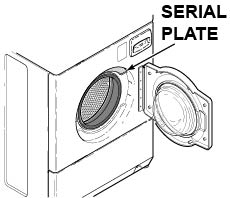
Manufacturer guides show nameplates around the door opening on front-load machines. On stacked equipment, check the relevant machine section as well. Position can vary with the production version.

Manufacturer guides show rear or upper cabinet positions. Some hardmount machines also carry identification inside the door. Use the model-specific guide if the plate is not in the illustrated position.
Send the exact model, serial number, part number if known, required quantity, vessel name and delivery port. Add a component photo or marked drawing when the part cannot be identified from its number alone.
PRIMUS SPARE PARTS
Choose your machine to browse its listed spare parts, starting with six parts. Use Load more to expand the list. Narrow the list by exact model or version, or search by part number or description. Add several parts to one enquiry and include your nameplate photo or parts list. Your model and serial number stay with each selected line.
Find Primus spare part references by number, description or machine model. Select the model from the nameplate to narrow your search. Catalogue matches are candidates; the serial number and machine configuration determine the correct part.
Add the parts and quantities you need to one enquiry, or upload your own RFQ or parts list. If your number is not listed, send it to us with a nameplate photo or drawing and we will help identify it.
Add parts, attach your own RFQ, or use both.
PRACTICAL QUESTIONS
From choosing the installation to identifying a replacement part, these are the details we help you work through.
Hardmount machines use a fixed mounting arrangement; softmount machines have a suspended washing assembly. We consider the foundation, fixing requirements and available space before recommending RX or FX. A softmount design does not remove the need to check the installation requirements for the vessel.
We also need frequency, number of phases and the heating arrangement. Primus offers selected configurations for marine use, but the full electrical specification must match the vessel. A photo of the existing nameplate is a useful starting point.
The laundry has to complete both processes within the available operating hours. We consider load sizes, textile types, extraction and drying capacity together. Extraction performance affects how much moisture remains for the dryer to remove; it does not, on its own, establish the complete cycle time.
No. Ultrabalance estimates the load through the frequency converter, Smartload uses a weight entered by the operator, and Optiload uses weighing cells. We identify the system supported by the exact machine and explain what the crew needs to do.
SensoDry monitors residual moisture to help avoid continuing the drying process after the target has been reached. We check whether it is available on the selected dryer and match the control options to the textiles and operating requirements.
i-Trace provides status information, alerts and wash records with compatible equipment. It requires the appropriate control, gateway and internet connection. We assess those requirements against the vessel’s connectivity before including it in a proposal.
On front-loading machines, start around the door opening. Cabinet machines may have the plate at the rear or upper cabinet; on stacked equipment, check the relevant washer or dryer section. The illustrations above are guides, because the position can change with the production version.
A familiar model name can cover different generations, controls, heating systems and electrical configurations. Parts can change at a serial-number boundary. Send a clear photo of the whole plate so we can check the catalogue reference against your machine.
It shows a reference listed in the relevant catalogue. Open its catalogue notes for positions and version information, then include the nameplate details in your enquiry. We still need to confirm suitability and availability before quoting.
Send a component photo, a marked drawing or your own parts list. For several machines, select each machine and enter its serial number before adding its parts. The finder keeps that information with each enquiry line, so the same part can be requested for different machines.
